A few months ago I was poking at OpenClaw on a throwaway side project, just to see what it could do. At some point I told it, in plain English, to go do a small recurring task for me. It went off, wrote a cron job, wired up the connector, and that was it.
I sat there for a second. The thing my last company had spent weeks building in n8n, the scheduling, the integrations, the glue between them, was just there. Because the agent already had connectors and could talk to a scheduler, the entire integration layer that made a tool like n8n valuable had quietly evaporated. You said what you wanted and it set itself up.
Then the second thought arrived, and it was the one that mattered. I would never let this run anything I actually cared about. Not unattended, and definitely not in a business.
That gap is the whole story. The setup problem is mostly solved. The trust problem is not. This post is about the piece that is missing, which I have started calling the overseer.
The no-code pipeline that wasn't
First, some credit where it is due. n8n solved a real problem, and it is still the right tool for plenty of jobs. Recurring work needs to run on a schedule, survive restarts, and keep going when you are not watching. That is durable execution, and it is genuinely hard. n8n made it approachable.
The trouble showed up at both ends, the authoring and the execution.
At my last company we needed to automate outreach. Pull prospects out of the CRM, decide who was inbound and who was outbound, draft a personalized message for each, enrich it with data from the web, and send the email. On paper this was going to be a clean, non-technical pipeline that a non-engineer could own.
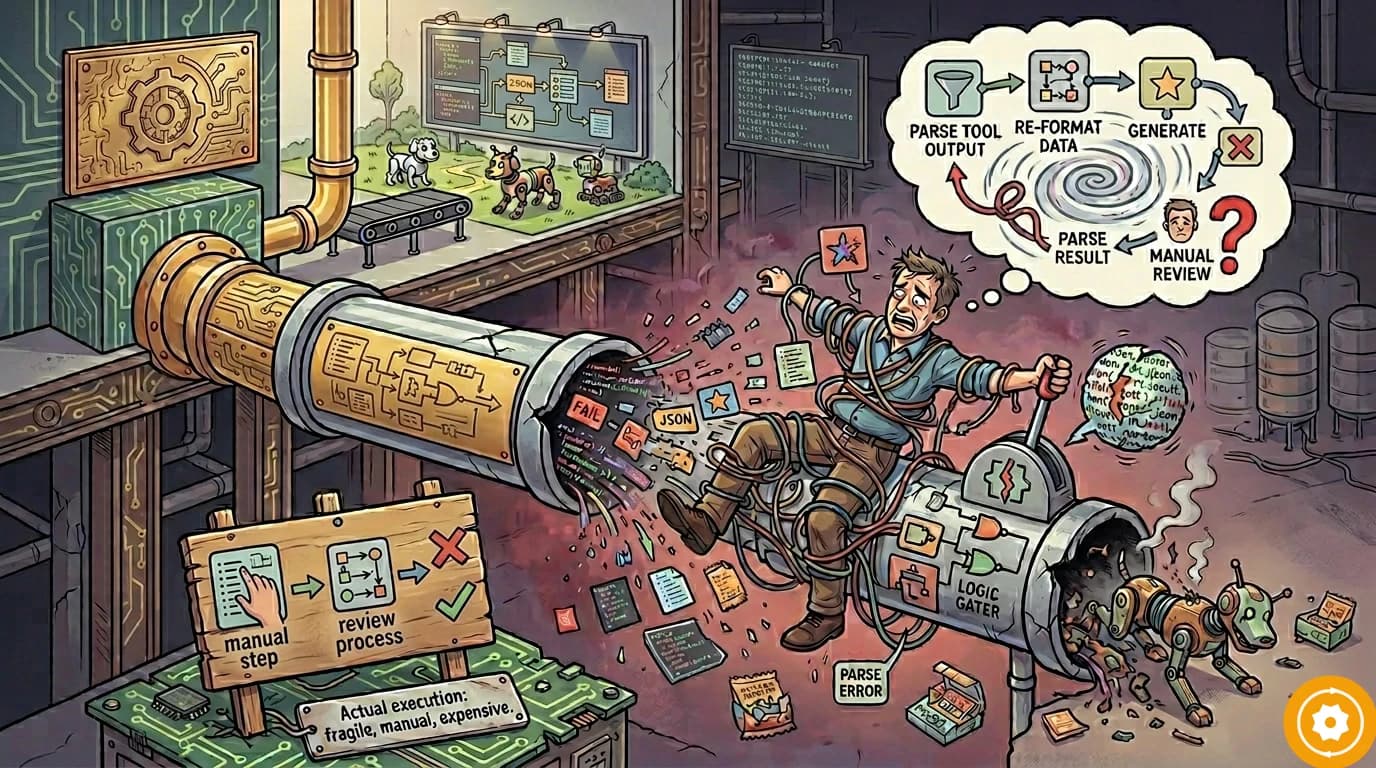
It did not stay that way. We needed code to split and reshape the data streams. The LLM steps were heavily constrained, and the models kept returning output we could not use directly, so we had to define structured tool outputs and add parsing steps just to turn text back into objects the pipeline could process. On top of that the thing was flaky. The AI step would time out, or return nothing, or quietly misbehave. What was sold as a no-code workflow had become a very technical, very fragile process that someone had to keep nursing.
The reason the authoring was painful is the reason the visual-workflow model exists at all. You have to pre-specify every branch up front, because you cannot trust the runtime to improvise. The graph pins down behavior you do not trust to be flexible. A capable agent removes that cost. You describe the task once, in words, and it works out the steps.
But the execution problem does not disappear with it. Those tools guarantee durable execution for deterministic steps, and an LLM step is not deterministic. The moment one sits in the middle of the pipeline, the guarantees you were leaning on stop holding, which is why ours kept timing out and going quiet. So the authoring gets easier and the execution gets harder, and you are left needing a runtime built for non-deterministic work from the start.
What agents took, and what they left behind
Agent connectors took the integrator moat. The hard, defensible part of the old tools was the long list of integrations and the wiring between them. An agent with connectors and a scheduler does that for free, on demand, from a sentence.
What they did not give you is the ability to walk away.
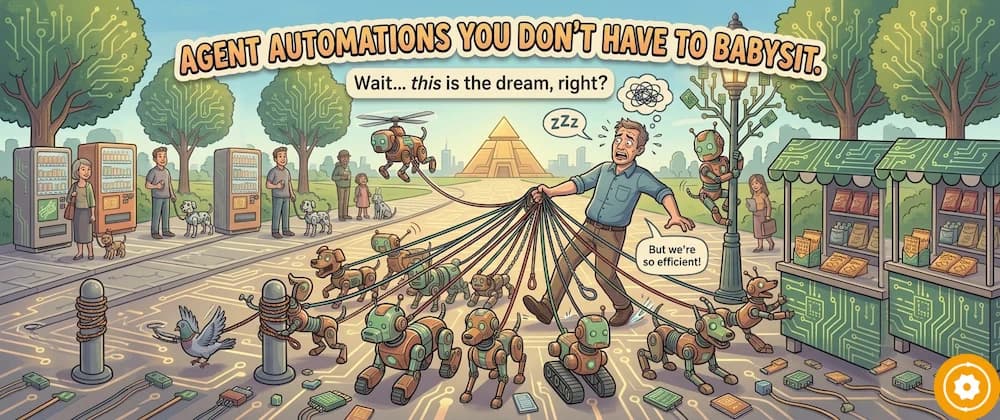
A capable local agent will happily do broad work for you. But to run it unattended you have two options, and both are bad. You let it ask permission on every step, which means you are still sitting there, so nothing was actually offloaded. Or you let it run on its own and hope, which is fine for a toy and unthinkable for anything that matters. These agents were also never built to run in the cloud under a real permissions model, scoped to exactly the access a single job needs.
So the bottleneck moves. It is no longer setup, and it is no longer capability. The bottleneck is you, watching. Run one automation and you can keep an eye on it. Run ten or twenty and watching for the one that broke becomes a full-time job. You saturate, not because the agents cannot do the work, but because you cannot review all of it.
That is the part I wanted to solve.
What it takes to stop watching
The list of things that have to be true before you can leave a job alone is short and mostly boring. The job has to run when it should and fail loudly when it cannot. It has to be scoped to exactly the access it needs and sandboxed, so a job that goes wrong cannot wander into things it should never touch. And something has to watch each run and decide, every time, whether to escalate it to you or stay quiet. With deterministic code, success is a binary you can check: the test passed or it did not. With an agent there is no such hard criterion, so whether a run actually went well is a judgment, not a check. The first two are table stakes. The last one is the whole game. It is what makes review scale at all, separating the runs you can safely ignore from the few that actually need you.
And that watcher has to be separate from the worker. An agent grading its own work skews positive, which is why Anthropic's recent harness work pairs a generator with a separate evaluator instead of asking one agent to do both. The worker wants to finish. The checker has to want to find the problem.
So I built that watcher
It is called Golemry. It is the layer the local agent never had: infrastructure for the recurring work.
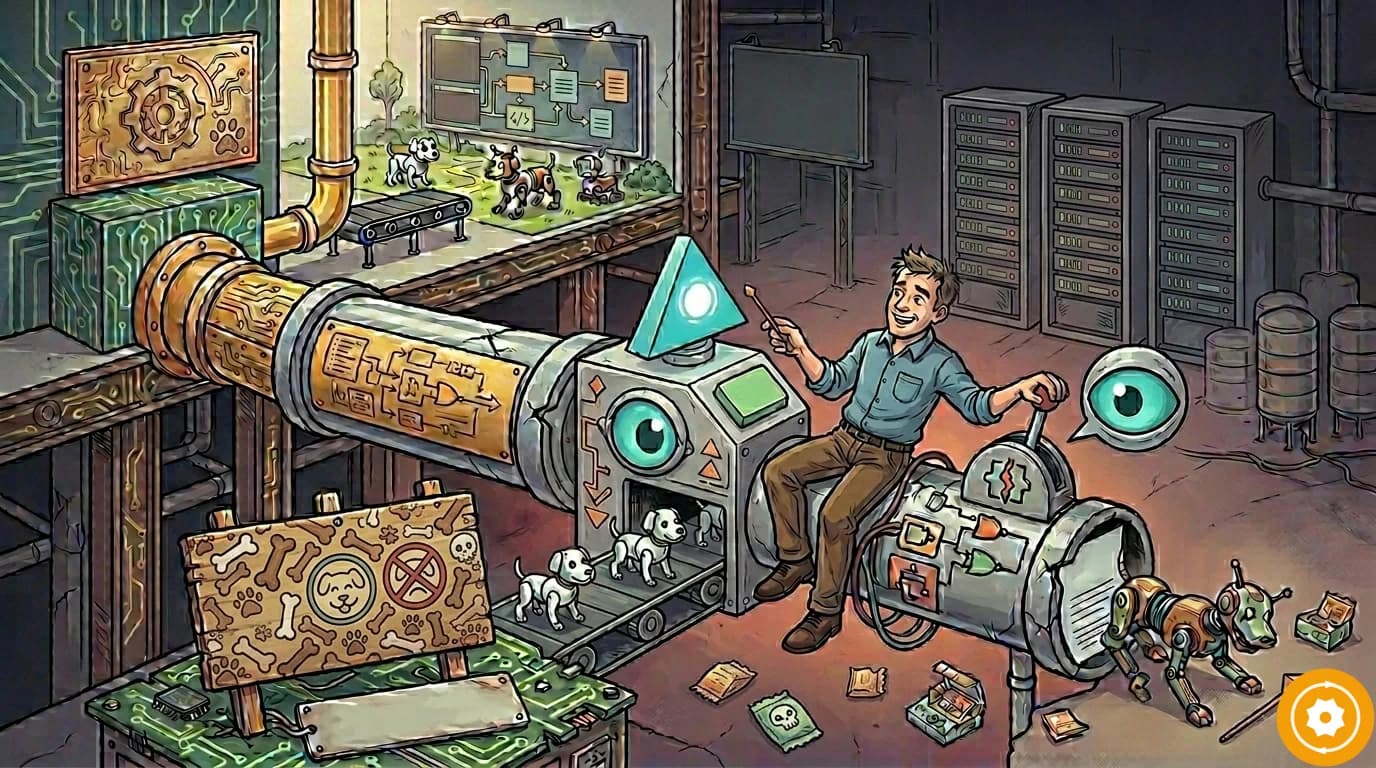
You add it to the agent you already use as an MCP server. You describe a recurring task in plain language, your agent sets up the job, and from then on the job runs on Golemry, on a schedule, scoped to its tools, sandboxed, with an overseer reviewing every run and pulling you in only when something looks off. Your agent stays the interface. It sets the jobs up, checks what ran, and hands you the one thing that needs you.
Here is the kind of thing it catches. I had a weekly research job that kept emailing me a normal-looking overview while the work behind it quietly went shallow. The output never gave it away, but the overseer reads the run and not just the result, so it caught the reasoning going thin and flagged the job as outdated. Nothing in the email would ever have told me.
Your agent, minus the babysitting
Picture the agent you use now, connectors and all, handling your daily back-and-forth. Now it grows one new ability. Anything recurring, the weekly research overview, the crawl for post ideas and drafts, the report you would otherwise check every morning, it can hand off to something built to be left alone and trusted to call you back.
That is the difference between automations that compound and automations that strangle you. You stop being the ceiling on how many can run at once. And because the running and the permissions live in the infrastructure rather than on your machine, you can finally point an agent at this in places you never would have before.
Building this in public
I would rather be precise than impressive, so here is the honest state of it.
Today, in V1: scheduled jobs set up through the MCP server from your agent, sandboxed runs, each job scoped to the tools it needs, a large library of connectors, and the overseer reviewing each run after the fact and escalating with a verdict by email and a notification.
Next: human-in-the-loop tooling, where the overseer weighs in on a proposed action before it goes out, and event-based triggers, so a job can fire on something happening rather than only on a clock.
Still open: the feedback loop and learning piece, where the overseer's verdicts and your responses become a threshold the job tunes over time, escalating a little less as a job earns trust and a little more when it slips. The crux here is how to expose this in an intuitive way and how to scope it.
The goal does not change at any stage. Move from watching everything to watching almost nothing, gradually, on guarantees you can point at instead of a feeling you hope holds.