Many people are automating with AI right now, and the tooling landscape has become confusing. Chat assistants with connectors, skills, schedulers, workflow builders with LLM steps, agent platforms, vertical suites. They all claim to automate your work, and they are all sort of right, for different kinds of work.
Here is the map I use to sort this out. One scoping note: I am leaving coding out, it is its own landscape with its own verification story and deserves its own post. Everything below is about business and knowledge work.
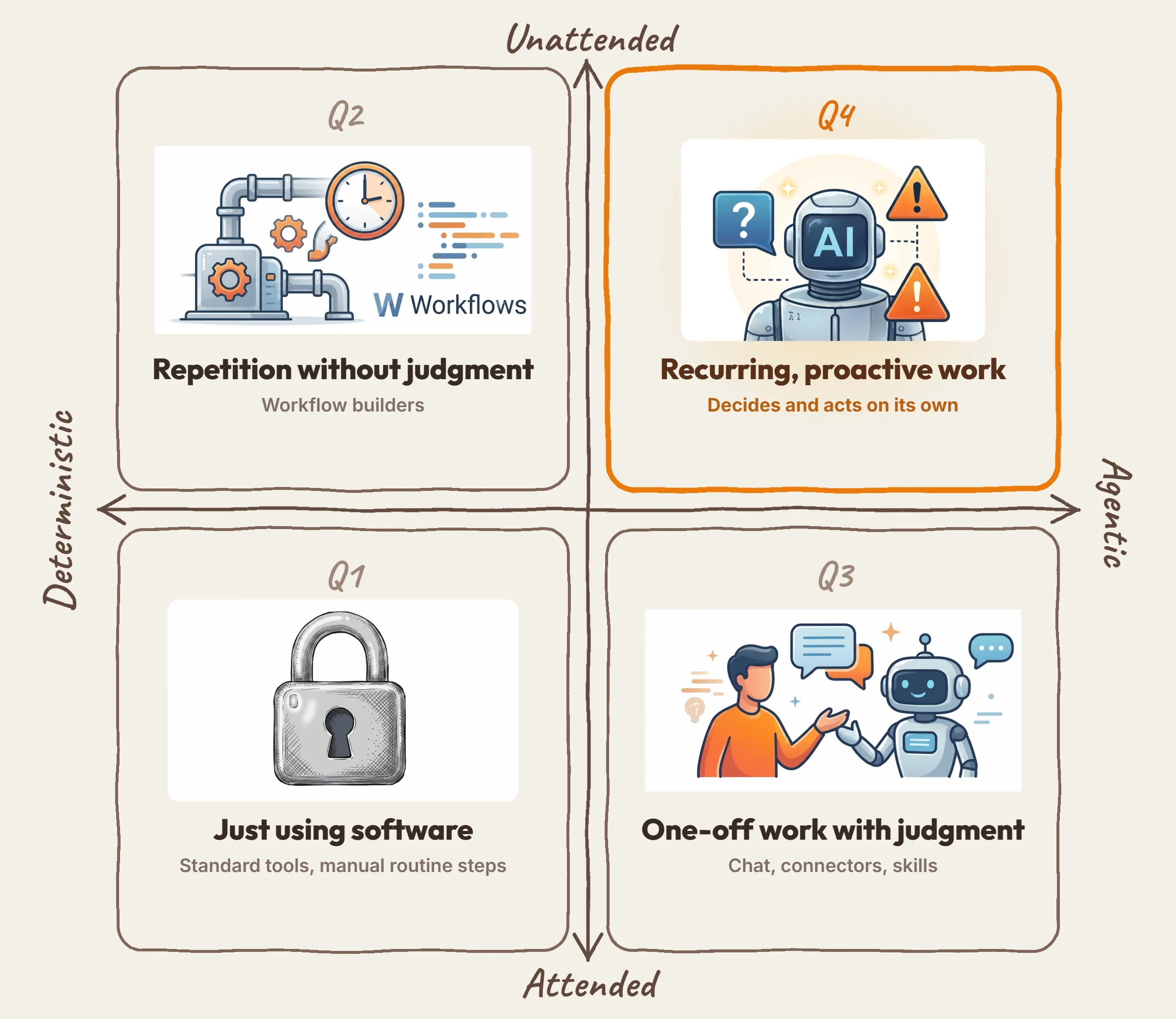
Quadrant 2: unattended + deterministic (repetition without judgment)
n8n, Zapier, Make. These run while you sleep, and they are reliable precisely because they are rigid: when X happens, do Y, no judgment involved, nothing to get wrong except the plumbing. If your task is truly deterministic, this is the correct quadrant and an agent would only add cost and variance. The trouble starts when the task needs actual judgment and the workaround is an LLM step in the middle of the workflow. You get a deterministic pipe with a stochastic segment: the pipe cannot reason about what the LLM produced, and the LLM cannot recover when the pipe feeds it something unexpected.
In practice this setup is how a lot of unattended agentic work gets done today, not because it is the right tool but because it is the tool people already have. I did the same, and the failure mode was always the same: the run is green. One of my own monitoring jobs finished cleanly, seven rows written, no errors, and a review afterward found an ignored filter rule, a duplicated entry, and three plausible-looking values that were simply wrong. The engine reports success because it checks that steps executed, not whether the judgment in the middle was any good. I wrote that story up here.
Quadrant 3: attended + agentic (one-off work with judgment)
This is where most people experience AI automation today. You sit in a chat with Claude or another assistant, you have your calendar, mail, and docs connected, and you delegate: search this, draft that, pull the context from those three places and summarize it. Skills let you package recurring shapes of tasks so you do not have to re-explain them every time.
I use this constantly, and I want to be clear: this quadrant does not need to change. One-off tasks are naturally attended. You steer mid-task, you catch the wrong recipient before a draft goes out, you notice when the agent pulled the wrong document. Errors die young because you are watching. The reliability of this quadrant is not a property of the agent. It is a property of you sitting there.
That is not a flaw, it is the design. The only limit worth naming is that attended automation saves effort but not attention. It cannot run at 7am without you.
Quadrant 4: unattended + agentic (recurring work with judgment)
The youngest quadrant, and it exists because a real category of work exists: tasks that repeat or should happen proactively, and that need judgment each time. Monitoring things and deciding what matters, triaging what came in overnight, preparing work before you ask for it. Too repetitive to do attended, too judgment-heavy to do deterministically.
Several kinds of tools are trying to serve this category, and their origins show. The chat providers extend their assistants with schedulers, today mostly for read-only work like briefings. Independent agent frameworks like OpenClaw and Hermes run unattended with real access, often with more enthusiasm than safeguards. The workflow builders add agent products on top, Lindy, Zapier Agents and similar, where you state a goal, grant access, and set a schedule. The public reporting is consistent: short chains work, longer chains drift, and the recurring unattended runs are where users report getting burned.
And the vertical suites build the whole thing for one narrow domain. I have first-hand experience there: at Octomind we built exactly this for website testing, and what made it work was not a smarter agent but the dedicated harness around it, verification built into the domain plus human interaction points to surface and control the system.
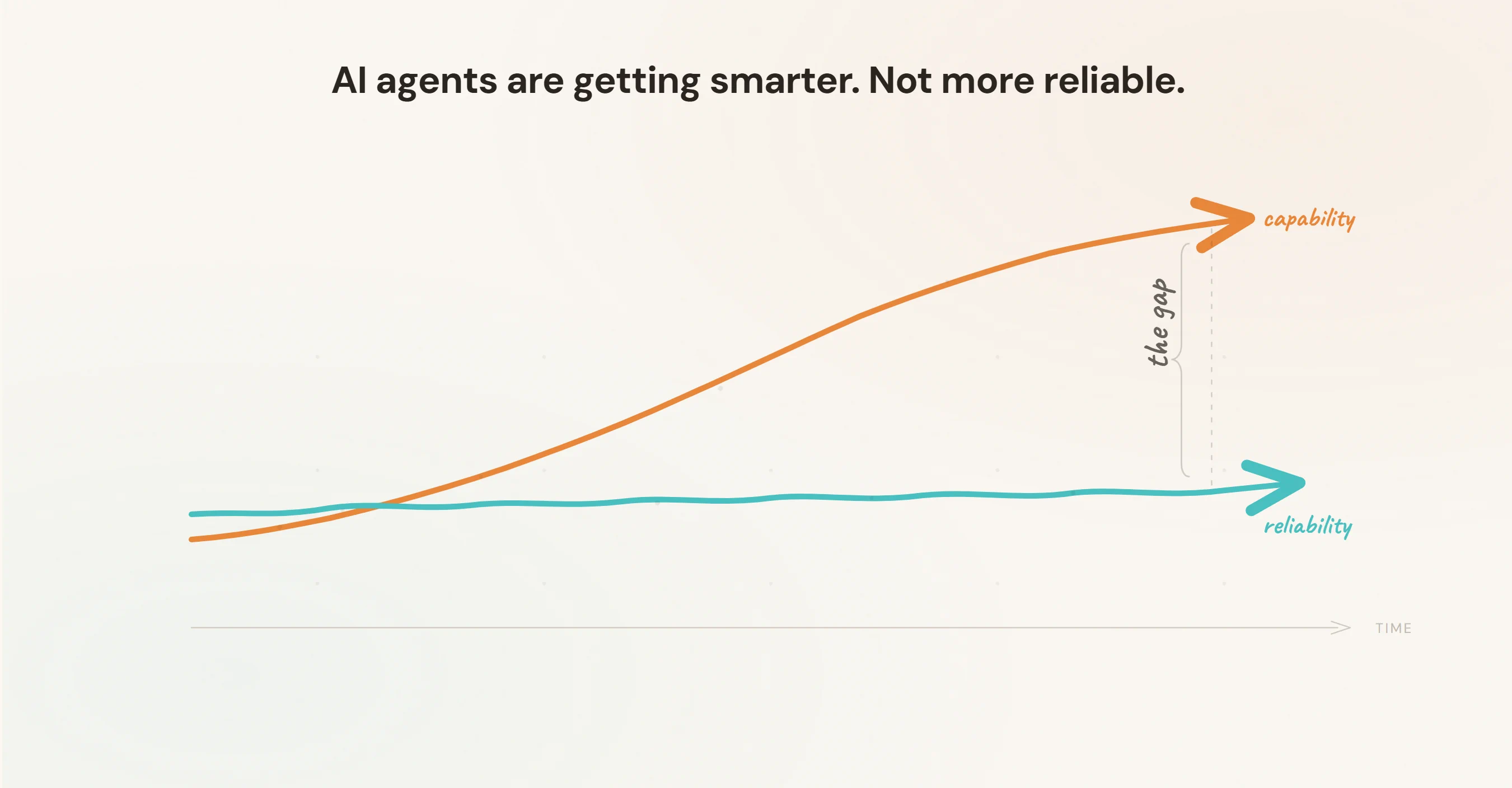
Agents ship with capability. Safety and reliability have to be built around them.
That is the pattern underneath quadrant 4, and it is the sentence this post exists for.
An agent with tools is pure capability. Models keep getting better, connectors keep multiplying, and none of that is the bottleneck anymore. What is missing is the counterpart: the part that faces the real world the agent acts in and makes the whole thing trustworthy. When I break down what "I can trust this agent unattended" actually requires, I get three parts:
-
Safe. The agent cannot cause damage outside its mandate: scoped tools and permissions, sandboxed infrastructure, credentials that cannot leak, resistance to prompt injection. Zapier for example ships PII redaction and injection detection. This part is being worked on across the industry.
-
Reliable execution. No run is silently swallowed: retries, durable state, surviving API timeouts. This is hard engineering, and plenty of tools still get it wrong today, n8n included. But it is solvable with known patterns, and the serious players are investing here. Lindy for example moved its agent execution onto Temporal for exactly this.
-
Reliable AI. The run did what it should have done, and what it claimed to have finished is actually finished. Not "did it execute", not "was it contained", but "was it right, this time".
The industry is investing in safety and execution and mostly skipping the last part. That is understandable: the first two are hard but conventional engineering problems, with known patterns and a clear definition of done. Reliable AI has neither. It requires judgment about a specific run in a specific context, which is exactly what you cannot get from retries and filters. Your platform can guarantee that your morning brief job ran at 7am. Nothing checks whether the brief was wrong.
This is the capability-reliability gap from earlier, seen from the tooling side. Quadrant 4 is a legitimate category with real demand, and it is currently served mostly by tools that brought their capability along and left the counterpart behind.
How to make unattended agent work trustworthy
If reliable AI cannot come from retries and filters, it has to come from supervision: something independent that looks at each run and judges the outcome. The obvious objection: if AI reviews AI, why trust the reviewer? Because you do not ask the reviewer to be right, you ask it to classify and escalate with a safety margin. Flagging a run as "a human should look at this" is a much easier problem than doing the task correctly in the first place. The catch is false positives: a noisy signal is one nobody reads, so escalate too often and people tune it out, and you are back to trusting runs blind. The real work is driving false positives down without narrowing the margin so far that real failures slip through.

That balance is reachable with a static reviewer today: a well-tuned one already makes unattended runs something you can trust, no learning required. Feedback is how it gets better over time, as a recurring task raises the same escalations over and over and those resolutions tune the reviewer, and eventually the agent, to stop flagging what keeps turning out fine. That learning loop is where this is heading, and it is the hard part: keeping a reviewer that tunes itself from drifting off course is a problem no one has solved yet.
Golemry is my attempt to build this as infrastructure: recurring agent jobs where an independent overseer reviews every run and escalates what needs human attention, available to any agent rather than tied to one framework or one vertical. There may be others working on this layer, and honestly, there should be.
The takeaway
If a task is one-off and needs judgment, do it attended, that works today. If it is truly deterministic repetition, use a workflow builder, that works too. And if it repeats and needs judgment, you are in quadrant 4, and before you trust any tool there, ask what it does after the run. If you are choosing between concrete options for a recurring task today, I compared them here.
Quadrant 4 is not solved by more capable agents. It is solved by what you build around them.